
QUICK OVERVIEW
On 12 November 2026, Google made its new AI model, Gemini 4 Hydrogen, the engine behind the AI answers in Search for everyone. Google now handles long, specific questions better. It splits one question into several smaller searches and draws on a wider range of websites to build its answer. For your practice, the goal shifts from ranking for one phrase to answering the real questions clients ask. The best source of those questions is your own consult room. Add short, plain answers to your service pages, keep your FAQs open, and match your Google Business Profile to your website.
You open your phone between clients. Another post tells you Google has changed everything, again.
Your stomach tightens a little. You trained to help people, not to chase search engines.
Take a breath. I have read Google's announcement closely, and most of what it rewards is something you already do many times a day: answer real questions clearly.
Here is what changed, and how to turn what you say in clinic into pages Google can understand.
See it done live this Friday
At the Thriving Practitioners Friday Q&A, I will walk through this upgrade, then write and publish a blog post in AI Studio while you watch. Friday 20 November, 12 noon AEDT.
What did Google change on 12 November 2026?
Google brought a new AI model called Gemini 4 Hydrogen into Search for all users, worldwide. Google describes it as the biggest model upgrade to Search yet. It now sits behind AI Mode, and Google's Search team says it also handles the hardest questions in AI Overviews.
You can read Google's own announcement if you would like the source. Two changes matter for your practice.
Google understands messier questions
Google says the new model is better with questions that have several parts, very specific requests and spelling mistakes.
That is how your clients already talk. They do not think in keywords. They think in worries, circumstances and practical limits.
One question becomes many searches
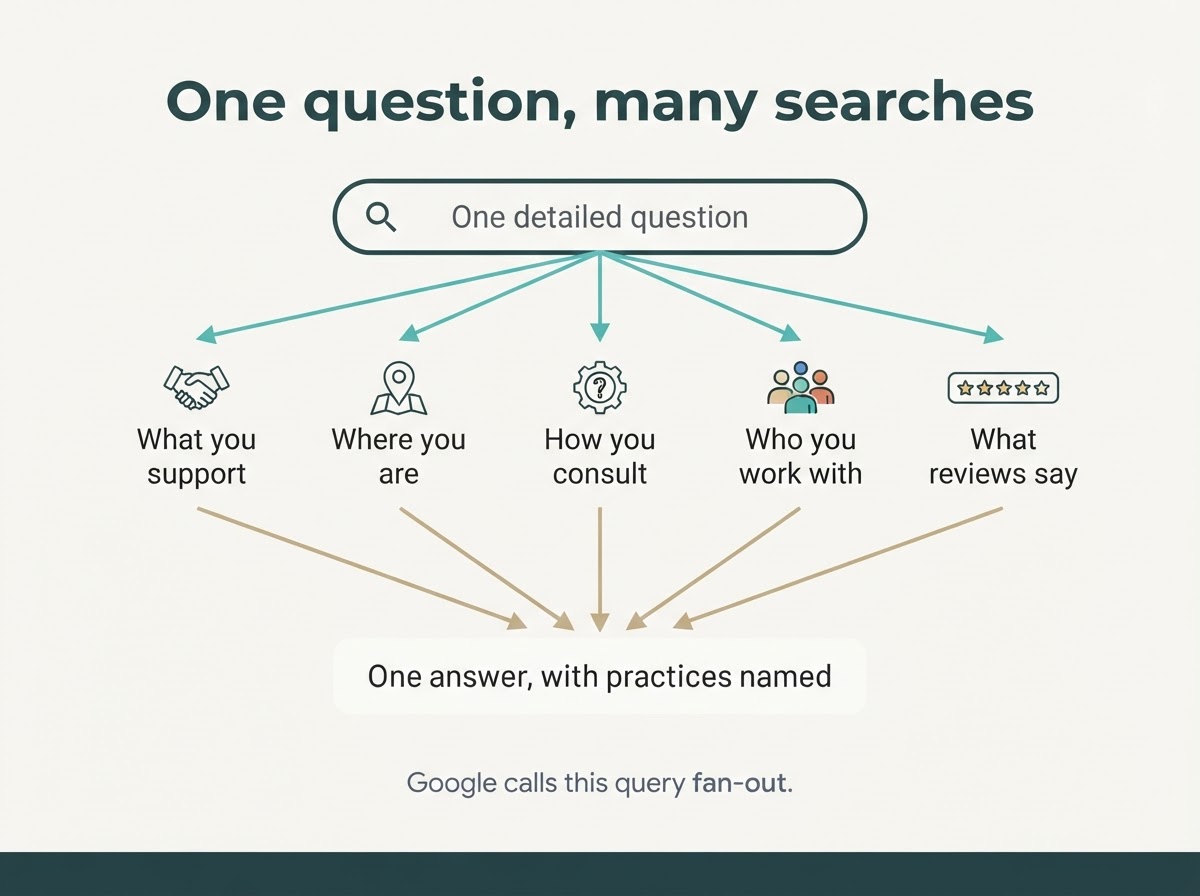
Google calls this query fan-out. Instead of running one search, Google breaks a question into smaller searches, runs them at the same time, then builds one answer from what it finds.
Google says this now connects people to a wider range of websites than before. Answers also carry more images, tables and structured layouts.
What does this look like for different practitioners?
People can now ask Google the kind of detailed question they once saved for a phone call. Google checks each part of that question separately, so the practices that are easiest to match are the ones whose pages answer each part in plain words.
Here are three illustrative examples. They are not real clients. They show the kind of question a person might ask, and what a practice would need on its website for Google to match it.
| Practitioner | A question someone might ask Google | What helps Google match the practice |
|---|---|---|
| Naturopath | A naturopath near me who works with women in perimenopause, offers online appointments after work, and explains what a first consultation involves | A named service page for perimenopause support, appointment times and online options stated plainly, and a short answer on what happens in a first consultation |
| Nutritionist | A nutritionist who works with families of fussy eaters, can see us during school hours, and gives practical meal ideas | A page for family nutrition that says who it is for, when appointments are available, and what a family takes home from a session |
| Western herbalist | A herbalist near me who makes up individual herbal formulas and can tell me what to bring to a first visit | A herbal medicine page that explains how formulas are prepared, what to bring, and when the herbalist would refer to other health practitioners |
Notice what each example rewards. Not the biggest website, and not the loudest marketing. It rewards being specific.
A website that says only "Naturopathy" on one general services page gives Google very little to match.
I've learnt that the most successful practitioners aren't necessarily the most talented clinically. They're the ones who understand that helping people find you is just as important as helping them heal.
Where do you find the questions your clients really ask?
In your own consult room. The questions clients ask you again and again, and the answers you give every week, are the best raw material you have. They are gold for this approach, because they are the same questions people now ask Google.
Most practitioners go looking for content ideas in keyword tools. You do not need to. You are already sitting on the answers.
Listen for the repeats
If you record or transcribe consults, with your client's consent, read back over a few weeks and listen for two things.
- The questions clients ask most often, in their own words. "How long before I come back?" "Do I need to stop what my other practitioner gave me?" "What do I bring to the first visit?"
- The answers you hear yourself giving. The explanation you have polished over hundreds of consults is usually clearer than anything you would write from scratch.
No transcripts? Keep a notepad on your desk for one week and jot down each question as you hear it. Your enquiry emails and your booking form are good sources too.
Keep client details out of it
Take away the general question and your general answer, nothing more. Never copy a client's words, story or health details onto your website or into an AI tool.
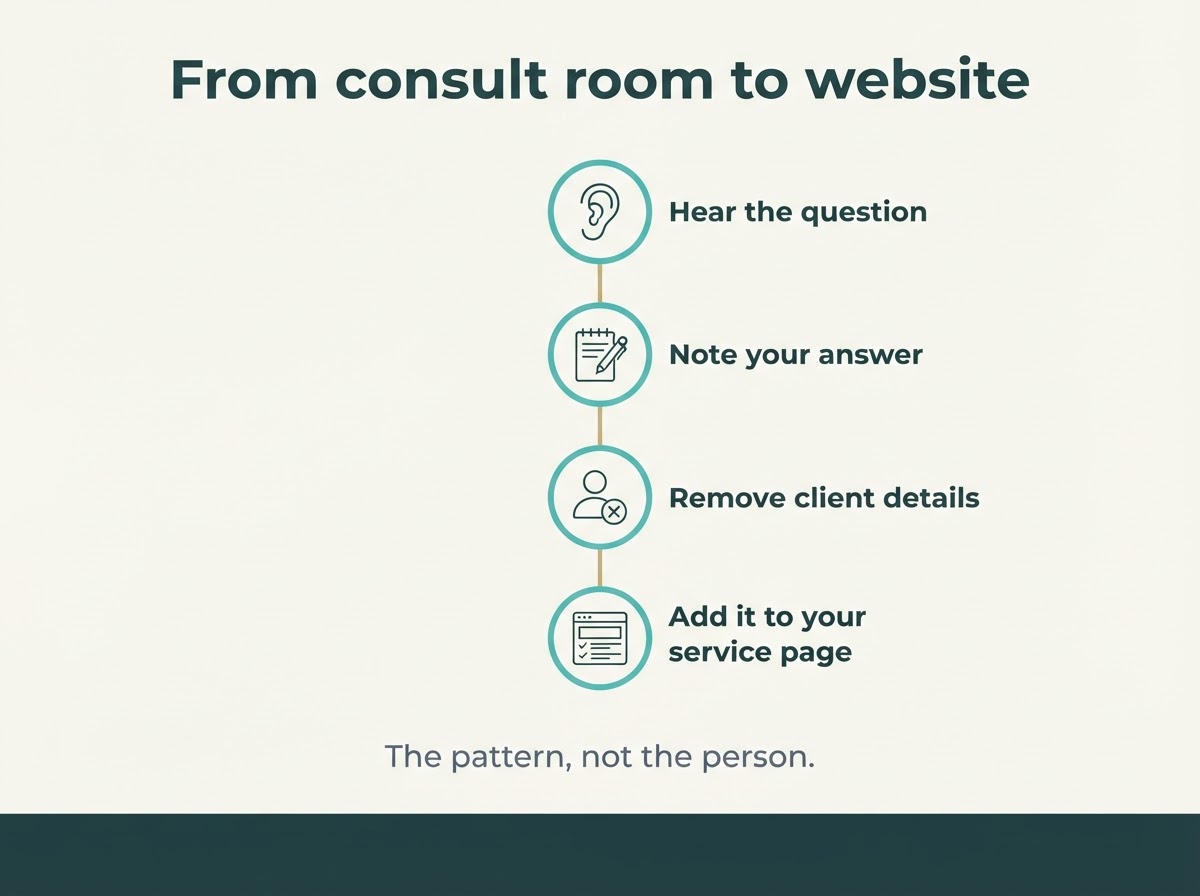
Recordings, transcripts and clinical notes stay in your practice management software. What moves to your website is the pattern, not the person.
Curious what a visibility plan looks like?
Our sample Visibility Roadmap shows how we map where a practice is being found, where it is being missed, and what to do first. It is free to read.
What should you add to your service pages?
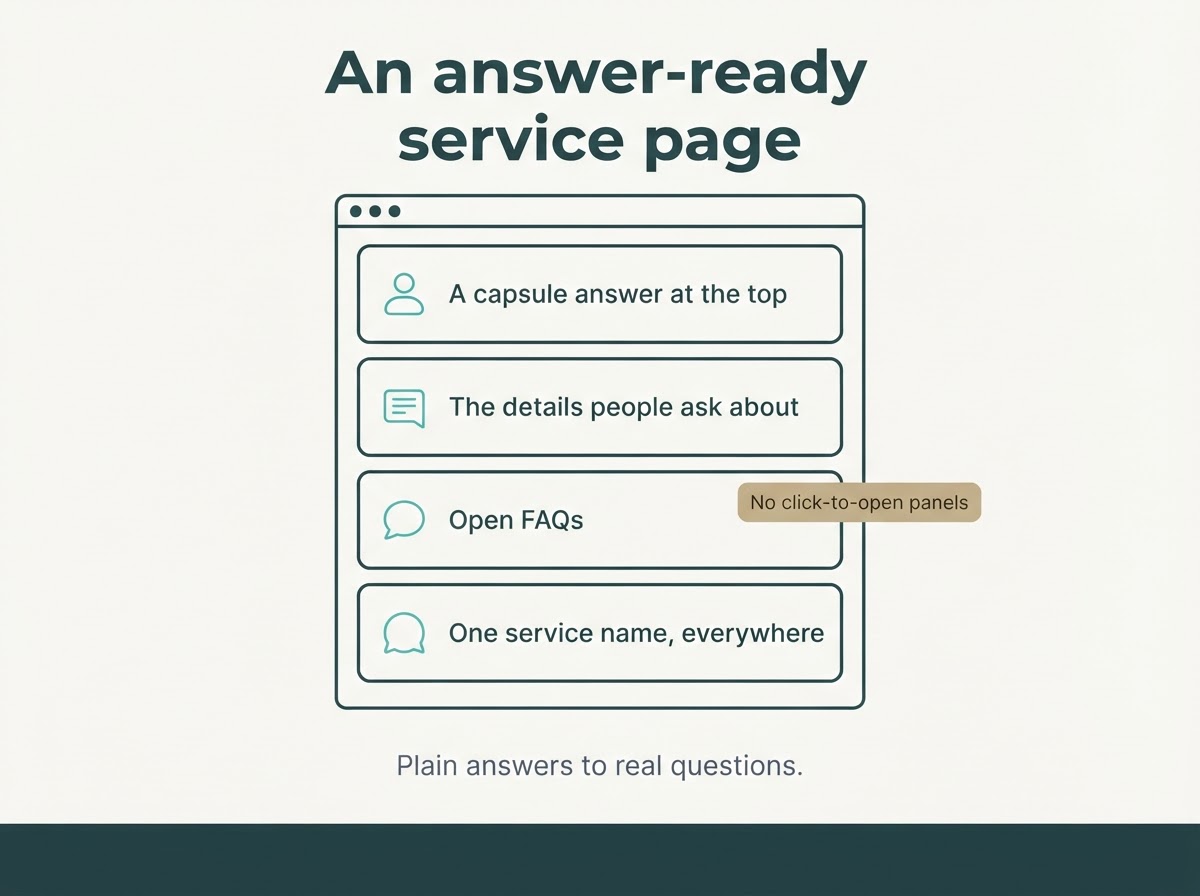
More plain information. Most service pages are too thin for Google to match against a detailed question. Add a short answer at the top, the practical details people ask about, and an open FAQ section built from your real client questions.
This is sometimes called answer engine optimisation. The principles are simple, and they read like good clinical communication.
Open with a capsule answer
A capsule answer is two or three sentences that fully answer one question and make sense on their own. Open each service page with one: what the service is, who it suits, and when you would refer to other health practitioners.
Describe what you do and who you support. Leave out promises about results. That keeps your writing honest, and within health advertising rules. You can read our approach to compliance for more on this.
Add the details people ask about
How long is a first consultation? Is it online or in person? What should a client bring? How do follow-ups work? If clients ask it, the page should say it.
Add FAQs, and keep them open
Put your repeat questions on the page as headings, each with a capsule answer beneath. Show them as open text. Answers hidden inside click-to-open panels are harder for AI tools to read.
Use one name for each service, everywhere
Use the same service name on your home page, on the service page and in your Google Business Profile. I cover this in Google Business Profile for natural health practitioners.
How do you keep this up without losing your weekends?
By making publishing easy. When your website, blog and Google Business Profile are connected in one place, a clear answer can go from your notes to your website in minutes, not days.
This is where many practices come unstuck. The website was built by one person, the profile was set up years ago, and adding a paragraph means emailing a developer.
Most practices do not have a marketing problem. They have a disconnected-systems problem.
That is the problem we built The Practice Growth System to solve. In one live Blueprint session we capture your story, your clients, your services and your voice. Your website, free guide and welcome newsletters are written in your voice and checked against advertising rules before anything goes live. Everything is connected on one platform, with your Google Business Profile aligned to match.
PractitionerPro is powered by HighLevel, which you may also see called GoHighLevel. HighLevel is built for marketing agencies, and on its own it arrives as a powerful, empty workshop. PractitionerPro is that technology already shaped around a natural health practice.
You do not need another piece of software. You need a practice-growth system that has already been designed around how natural health practitioners work.
This article is a small example. It was published on the PractitionerPro blog with AI Studio, the same way I will show you on Friday.
When I first discovered AI tools in 2022, I saw immediately how they could solve the biggest challenge facing practitioners: creating quality content consistently. But only if we use them to amplify our authentic voice, not replace it.
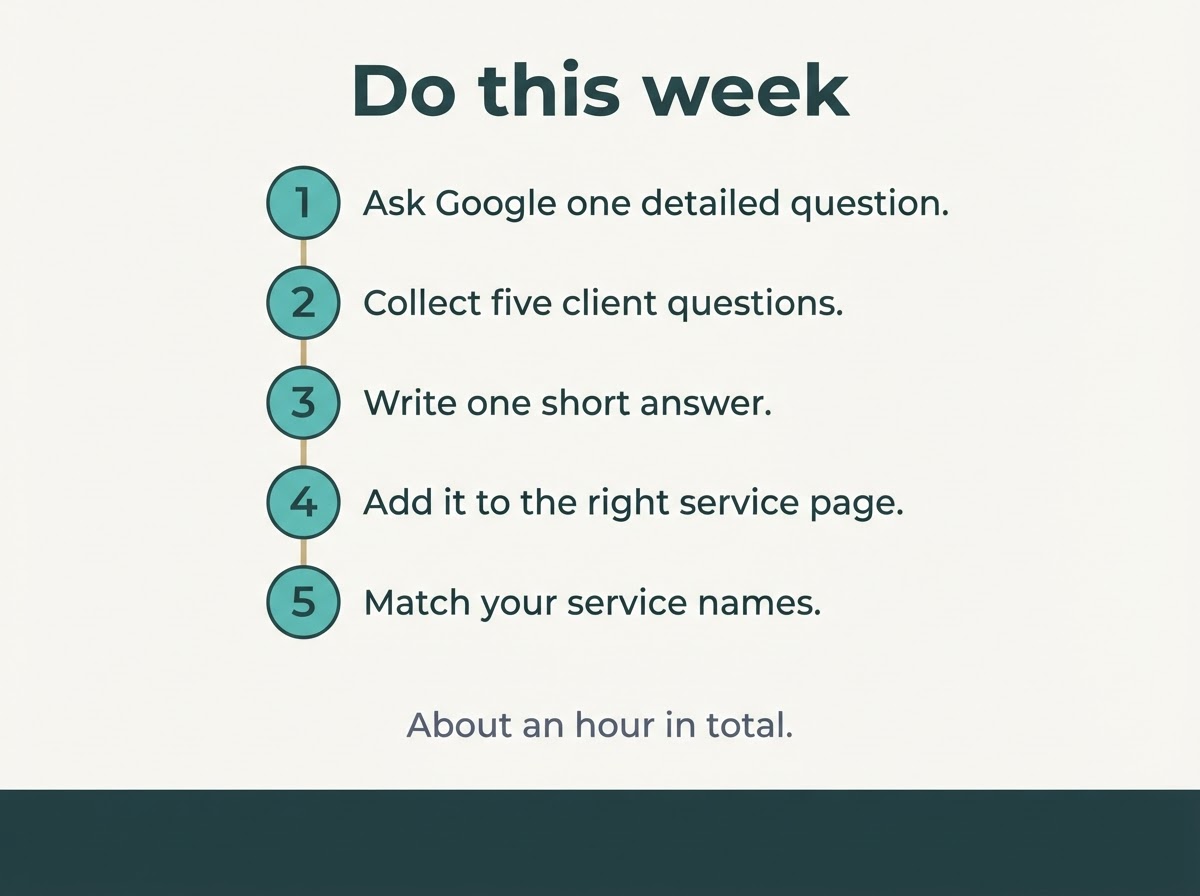
What can you do this week?
Five small steps, about an hour in total. None of them needs new software, and none of them needs a marketer.
- 1
Ask Google one detailed question. Type the kind of long, specific question a new client might ask about your area of practice and your suburb or town. Notice which practices are named.
- 2
Collect five client questions. Listen back over this week's consults, or your notes, for the questions you hear again and again. Write them in the client's words.
- 3
Write one short answer. Pick one question. Answer it in two or three plain sentences, the way you would say it in clinic.
- 4
Add it to the right service page. Put that answer near the top of the page, or in an open FAQ section. Say who the service suits and when you would refer on.
- 5
Match your service names. Check that each service has the same name on your home page, its own service page and your Google Business Profile.
Use this worksheet for steps two to four. The first row is an example.
| Client question, in their words | Your short answer | Page it belongs on |
|---|---|---|
| What do I bring to my first visit? | Two or three plain sentences, the way you say it in clinic | First consultation page, and its FAQs |
Frequently asked questions
Can someone check how my practice shows up in Google's AI answers?
Yes. That is part of what I do in a Free Practice Review. I look over your website and Google Business Profile before we speak, then we talk through how clearly Google can tell what you do and who you support.
Do I need to rebuild my website because of this upgrade?
No. Most practices need fuller, clearer service pages, not a new website. Add short answers to real client questions, an open FAQ section, and service names that match your Google Business Profile.
Is it all right to use consult transcripts for website content?
Yes, as a source of questions, never as a source of client details. Record or transcribe only with your client's consent, and take away the general question and your general answer, with nothing that could identify anyone. The recordings and notes themselves stay in your practice management software.
What is a capsule answer?
A capsule answer is a short, complete answer of two or three sentences that sits directly under a question. It makes sense on its own, so a person or an AI tool can lift it out and still understand it.
What is query fan-out, in plain words?
Query fan-out is Google's name for splitting one question into several smaller searches that run at the same time. Google then combines what it finds into a single answer, with links to the websites it drew on.
Can I use AI to write the answers on my website?
Yes, as a drafting assistant, once your own answers are captured. The value is in what you say in clinic every week, so start there and let AI help you tidy it. Then check every page against health advertising rules before it goes live. That means no claims about results and no clinical testimonials.
Is PractitionerPro the same as HighLevel?
No. PractitionerPro is powered by HighLevel, and it arrives already shaped around a natural health practice, with the strategy, writing, building and support included. HighLevel on its own is built for marketing agencies. You would be setting up an empty workshop yourself.
Where to from here?
Google will keep changing. What stays steady is the work underneath: knowing who you support, and saying it plainly wherever people look.
You already answer the questions. The task now is to let your website answer them too.
If you would like a second pair of eyes on how your practice looks to Google right now, I am happy to help.
Book a Free Practice Review
See how PractitionerPro can simplify your practice marketing system. I will look at your website and Google Business Profile before we speak, then we will talk through how clearly Google can tell what you do and who you support.
It is free, it is friendly, and there is no obligation.
Warmly,
James BurginFounder, PractitionerPro and Thriving Practitioners. Former naturopath, clinic owner and creator of Metaphysical SEO.

About The Author
James Burgin
Founder, PractitionerPro and Thriving Practitioners
James is a naturopath turned digital marketer with 35+ years helping natural health practitioners get found by the people they trained to help. He founded Thriving Practitioners, a community and education platform for practitioners across Australia and New Zealand, and PractitionerPro, the practice growth platform built by practitioners, for practitioners. He lives in Bondi, Sydney.