
QUICK OVERVIEW
You do not need to write new content to be found in Google's AI answers. Start by upgrading a page you already have. Add three things, which I call the GEO Trinity: a quote in your own words, a recent statistic and a credible source. Put a short answer under each question heading, add an at a glance table, and finish with a list of references. This article gives you everything you need to do it yourself: a free action plan, four prompts you can copy, and a Claude Skill. Allow about an hour for your first page.
You have written the page. It took a weekend, it says what you wanted to say, and you were proud of it.
Now you hear that Google has changed again, and you wonder whether it was wasted effort.
It was not. The page you wrote is your starting point. It needs an evidence layer, not a rewrite.
This is the practical follow-up to my earlier article, What Does Google's Biggest AI Search Upgrade Mean for Your Natural Health Practice?. If you have not read it, start there. It explains what changed and why. This one shows you what to do about it.
Why upgrade a page you already have?
Because it is the fastest way to a page Google's AI can use. Your existing page already carries your voice and your clinical thinking. What it usually lacks is short, liftable answers and facts a reader can check.
Google's AI now breaks one detailed question into several smaller searches, then builds one answer. Your page gets used when it answers one of those smaller questions clearly, and when its facts can be checked.
Think of it as a case history. One symptom tells you little. A consistent picture from several sources tells you a lot. Google is looking for that same consistent picture on your page.
What is the GEO Trinity?
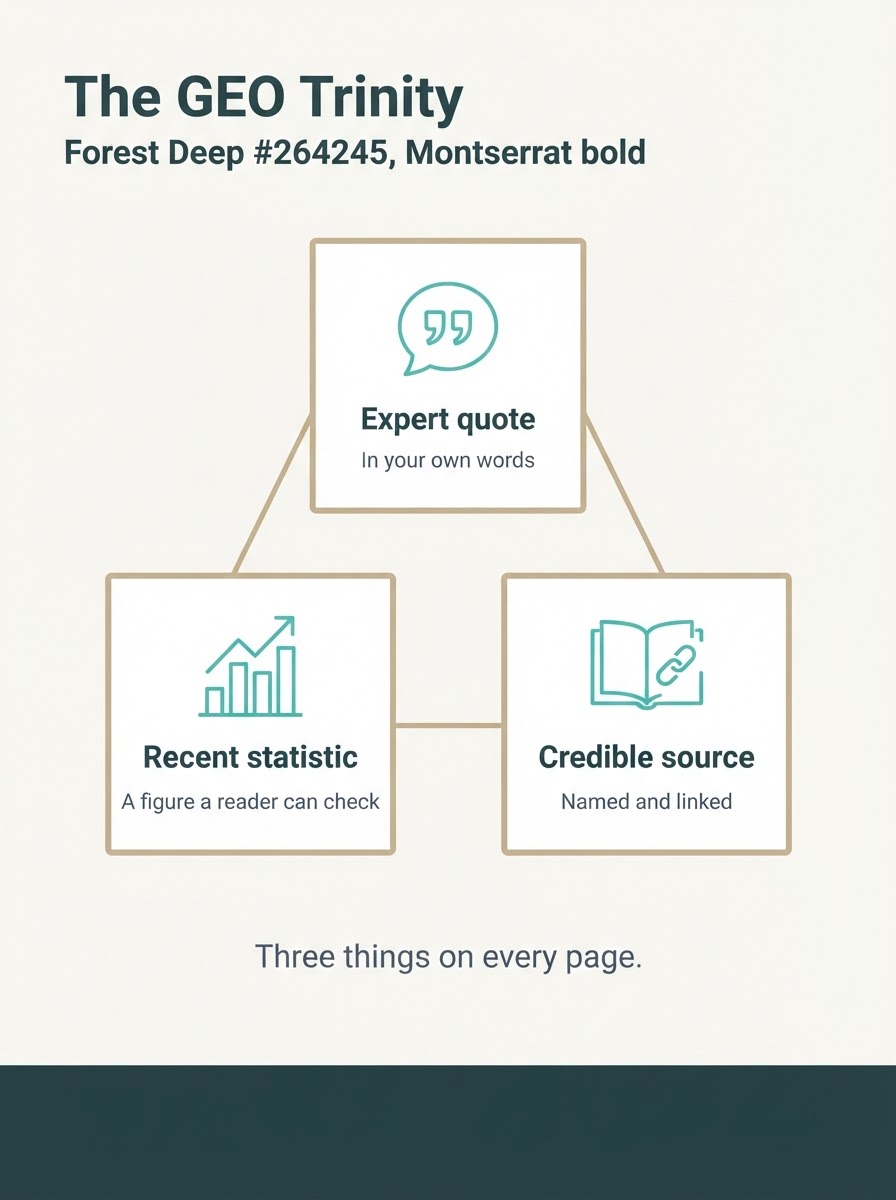
The GEO Trinity is the method I teach for content that AI tools can trust. Every page carries three things: an expert quote, a recent statistic and a credible source.
| Part | What it is | Where it comes from |
|---|---|---|
| Expert quote | One to three sentences in your own words, with your name and title | Something you already say in clinic or wrote on the page |
| Recent statistic | A figure a reader can check | A source published or reviewed in the last three years |
| Credible source | A named, linked authority | Government health services, professional colleges, journals |
AI isn't about replacing the human touch in healthcare. It's about amplifying your authentic voice so more people can discover your healing gifts.
What does an upgrade look like on a real page?
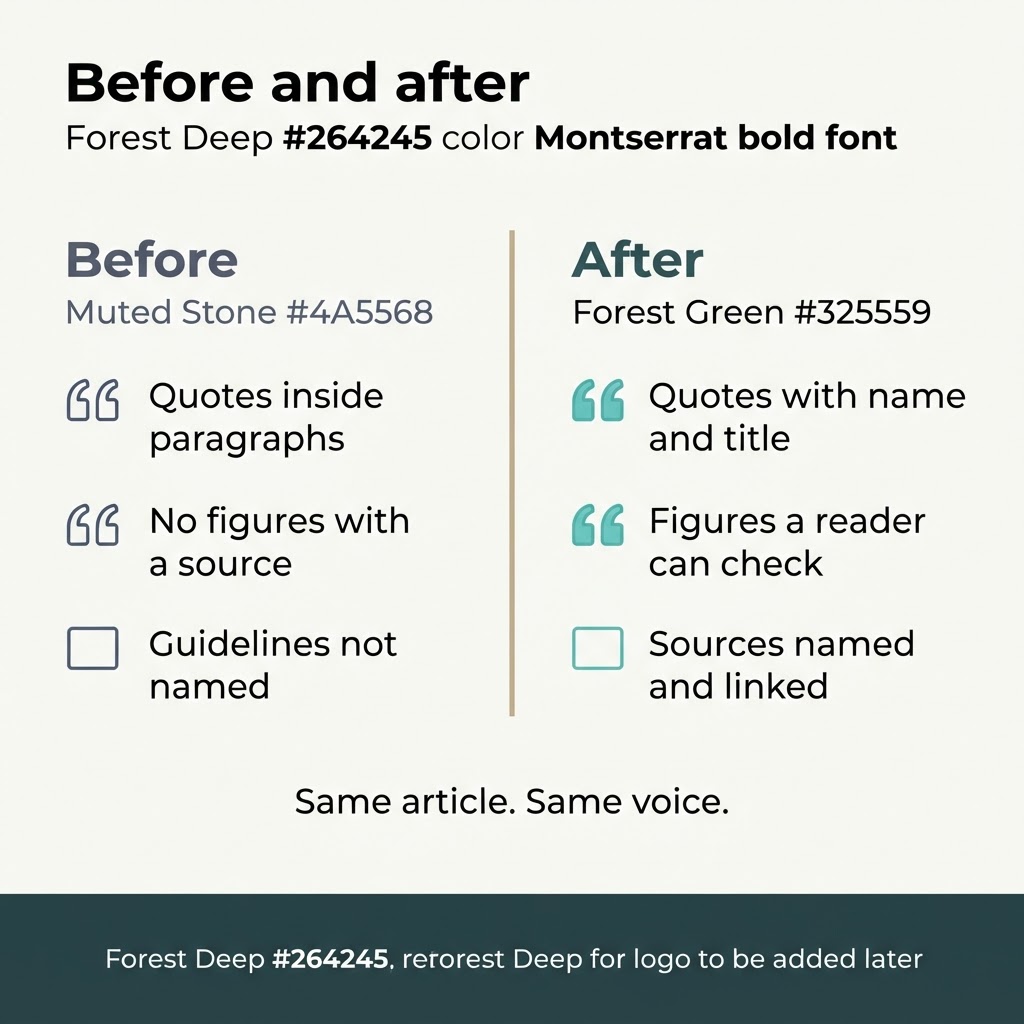
It looks like the same article with an evidence layer added. Nothing is removed, and the practitioner's wording stays. Quotes are attributed, sources are named and linked, and a table and a reference list are added.
Here is a real example, shared with permission. Sonia Savage is a Functional Nutritionist on Sydney's Northern Beaches. She wrote an article on preconception nutrition for both partners.
It was already a good article: a question headline, a short overview, question subheadings and open FAQs. It also had three strong lines in Sonia's own voice, including this one: "I only order a test if the result will change what we do."
What it did not have was a single named source. So we upgraded it in place.
| Part of the Trinity | Before | After |
|---|---|---|
| Expert quote | Three good lines from Sonia, sitting inside ordinary paragraphs | The same three lines, shown as quotes with her name and title |
| Recent statistic | General statements, with no figure tied to a source | Figures taken from pages reviewed in the last three years |
| Credible source | Australian guidelines mentioned, but not named | Five named Australian sources, linked in the text and listed at the end |
We also added a "Last updated" date, an at a glance table that answers seven short questions, and a References section at the end.
Sonia did not rewrite a word of her own. The upgrade took one instruction in her website builder.
Download the free upgrade kit
Three files, free to use: the Action Plan as a PDF and a Word document, the four prompts as a text file, and the answer-ready-content-upgrade Skill as a zip file for Claude.
How do you upgrade a page in seven steps?
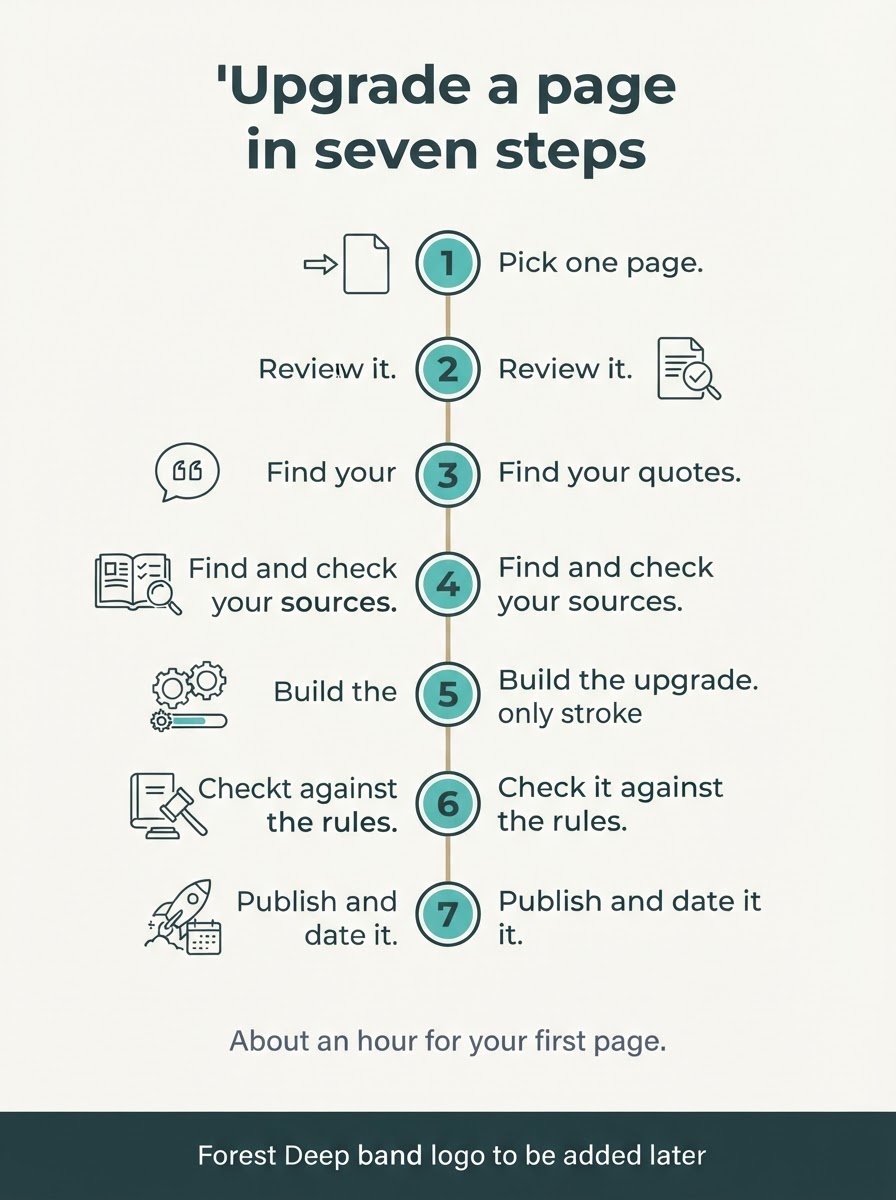
Pick one page, review it, find your quotes, find and check your sources, build the upgrade, check it against the rules, then publish and date it. The Action Plan walks you through each step with a time guide.
- 1
Pick one page. Choose a service page or blog post about something you are happy to be known for.
- 2
Review it. Use Prompt 1 below. You get a score out of 10 and your three priority changes.
- 3
Find your quotes. Look for strong sentences you have already written in the first person. Use your own words only.
- 4
Find and check your sources. Use Prompt 2, then open every link yourself and check the figure is on the page.
- 5
Build the upgrade. Use Prompt 3. You get the exact additions and where each one goes.
- 6
Check it against the rules. No claims to treat, cure or prevent, no promised results, and no client details.
- 7
Publish and date it. Add the changes, then add a "Last updated" line with today's date.
Step four matters most. AI tools can get sources wrong. Open every link, find the figure on the page, and make sure it says what the AI told you it says.
Which prompts can you copy and use?
There are four. Use the first three in order on one page. The fourth turns the questions you hear in clinic into short answers for a service page. Copy each one in full and replace the words in capitals with your own details.
Prompt 1: Review my page
This gives you a score out of 10 and your three priority changes.
You are helping a natural health practitioner improve one page of their website so that Google's AI answers and other AI tools can understand, trust and cite it.

Here is my page: PASTE THE WEB ADDRESS OR THE FULL TEXT
I am: YOUR NAME, YOUR QUALIFICATION, YOUR SUBURB AND COUNTRY

Score the page on these 10 checks. For each, answer Yes, Partly or No, with one line of evidence from the page.
1. The headline is a real question a client would ask.
2. A short summary near the top answers that question in full.
3. Every subheading that asks a question is followed by a two to four sentence answer that makes sense on its own.
4. The page says who it is for, where I am, and how I consult.
5. It includes at least one quote in my own words, attributed by name and title.
6. It includes at least one statistic or figure, with its source named.
7. It names and links at least two credible sources.
8. Questions and answers are shown as open text, not hidden in click-to-open panels.
9. It has a clear next step, and service names are used consistently.
10. It makes no claims to treat, cure or prevent, and includes no clinical testimonials.

Then give me my score out of 10 and the three changes that would help most. Do not rewrite the page yet. Use Australian English. Do not use em dashes.
Prompt 2: Find and check sources
Run this in the same conversation, straight after Prompt 1. Then open every link yourself.
Using the same page, list every factual statement that a careful reader might want a source for. Do not add new topics.

For each statement, search the web and find the best source. Prefer government health services, professional colleges, national guideline bodies and peer-reviewed journals from MY COUNTRY, published or reviewed in the last three years.

Give me a table with: the statement on my page, what the source actually says, the publisher and page title, the date it was published or last reviewed, and the full link.

Rules:
- Open each source and take the figure from the page itself. Never give a number, a study or a link from memory.
- If you cannot find a source, say so plainly and suggest how to reword the statement without the figure.
- If the best source is more than three years old, tell me.
- Four to six sources is enough.
Prompt 3: Build the upgrade
Paste in the sources you have checked and the quotes that are your own words.
Now write the upgrade for my page. This is an upgrade, not a rewrite. Keep my voice, my structure and my wording. Give me only the additions, each with the exact place it goes.

Use only the sources I have confirmed: PASTE THE SOURCES YOU CHECKED
Use only these quotes, which are my own words: PASTE YOUR QUOTES

Give me:
1. A "Last updated" line with today's date.
2. My quotes, formatted with my name and title beneath each.
3. A two to four sentence answer for any question heading that does not have one, drafted from what my page already says.
4. One or two sentences for each main section that name a source and link it, written in my first-person voice.
5. An "At a glance" table with three columns: question, short answer, source. Five to seven rows.
6. A numbered References list for the end of the page, with publisher, title, date and link, and today's date as the date accessed.
7. A short list headed "Check before you publish" with anything I should confirm.

Rules:
- No claims to treat, cure or prevent. Use "support", "may help" and "plays a role in". No promised results.
- No client names, stories or details. No testimonials.
- Present any guideline figure as what the guideline says, and add that individual needs differ.
- Speak about other health practitioners as partners in care.
- Australian English. No em dashes. No prices.
Prompt 4: Turn clinic questions into answers
Type in the general questions only. Never paste consult recordings, notes or anything that could identify a client.
I am a NATURAL HEALTH PRACTITIONER TYPE in SUBURB AND COUNTRY. Here are questions my clients often ask about SERVICE OR TOPIC, and roughly how I answer each one:

PASTE YOUR QUESTIONS AND YOUR OWN ANSWERS, IN GENERAL TERMS

For each question, write a short answer of two to three sentences that makes sense on its own, in my voice, using only what I have told you. Put the question as a heading and the answer beneath it.

Then tell me which page of my website each one belongs on.

Rules: no claims to treat, cure or prevent, no promised results, no client details. Australian English. No em dashes.
What is the Skill, and how do you use it?
A Skill is a saved set of instructions for Claude, so you do not have to paste the prompts each time. Once the answer-ready-content-upgrade Skill is added to your Claude account, you can say "Review and upgrade this page" and share your web address.
It runs the review, finds sources, and hands back the upgrade with a list of things to check before you publish.
It follows the same rules as the prompts: your voice, your own quotes, checked sources, and health advertising rules. The zip file is in the upgrade kit.
What should you check before you publish?
Check that every quote is yours, every figure is on the source page, and nothing promises a result. Then check that no client could be identified from anything on the page.
- Quotes: use your own words. Never let AI invent a quote, and never quote a client.
- Sources: open every link. Do not publish a number you have not seen on the source page.
- Claims: describe what you do and who you support. Do not say treat, cure or prevent.
- Guidelines: say whose guideline it is, and that individual needs differ.
- Privacy: your clinical notes and recordings stay in your practice management software. What moves to your website is the pattern, not the person.
You can read our approach to compliance for how we handle health advertising rules on the websites we build.
How do you get the changes onto your website?
That depends on your website. If you can edit your own pages, paste the additions in. If every change means emailing a developer, this is where most upgrades stall.
Most practices do not have a marketing problem. They have a disconnected-systems problem.
On PractitionerPro, Sonia's whole upgrade went in as one plain-English instruction. The page builder made the seven changes in place and left everything else alone. That is what we built The Practice Growth System to make possible: your website, blog, bookings and newsletters connected on one platform, written in your voice and checked against advertising rules.
PractitionerPro is powered by HighLevel, which you may also see called GoHighLevel. HighLevel is built for marketing agencies, and on its own it arrives as a powerful, empty workshop. PractitionerPro is that technology already shaped around a natural health practice.
You do not need another piece of software. You need a practice-growth system that has already been designed around how natural health practitioners work.
We're entering an era where ancient wisdom meets cutting-edge technology. The practitioners who thrive will be those who embrace AI as a tool to amplify their authentic voice while maintaining the integrity of their healing practice.
What can you do this week?
One thing: run Prompt 1 on one page. In ten minutes you will know your score and your three priorities.
- 1
Choose your page. Your most visited service page is a good place to start.
- 2
Run Prompt 1. Paste it into your AI assistant with your web address.
- 3
Write down your score. Use the scorecard below, then score the page again after you upgrade it.
| Check | Before | After |
|---|---|---|
| The headline is a real client question | ||
| A short summary near the top answers it | ||
| Each question heading has a short answer beneath it | ||
| It says who it is for, where you are and how you consult | ||
| At least one quote in your own words, with your name | ||
| At least one figure, with its source named | ||
| At least two credible sources, named and linked | ||
| Questions and answers are open, not click-to-open | ||
| A clear next step, with matching service names | ||
| No claims to treat, cure or prevent, no testimonials |
Frequently asked questions
Can someone look at my pages and tell me where to start?
Yes. That is part of a Free Practice Review. I look over your website and Google Business Profile before we speak, then we talk through which pages are worth upgrading first.
Do I need Claude, or will another AI assistant work?
The four prompts work in any capable AI assistant that can read a web page and search the web. The Skill is built for Claude, because Skills are a Claude feature.
How long does it take to upgrade one page?
Allow about an hour for your first page. Most of that time is checking your sources, which is the step you should not rush. Later pages go faster.
Can AI write my quotes for me?
No. A quote is only worth having if you said it. Use sentences you have already written, or answer a question out loud and write down your own words. The prompts are written to stop AI inventing quotes.
Is it all right to quote official guideline figures on my website?
Yes, when you name whose guideline it is, link to it, and make clear that individual needs differ. Present the figure as what the guideline says, not as your personal advice to the reader.
Will this guarantee that AI recommends my practice?
No, and be wary of anyone who promises that. Nobody outside Google knows exactly how practices are chosen for an answer. What this does is make your page clearer, easier to check and easier to quote.
Where to from here?
Start with one page. Give it the evidence it deserves, in your own voice, and date it.
Then read the earlier article again with that page in mind: What Does Google's Biggest AI Search Upgrade Mean for Your Natural Health Practice?. You will see your own page differently.
If you would like a second pair of eyes on which pages to upgrade first, I am happy to help.
Book a Free Practice Review
See how PractitionerPro can simplify your practice marketing system. I will look at your website and Google Business Profile before we speak, then we will talk through which pages are worth upgrading first.
It is free, it is friendly, and there is no obligation.
Warmly,
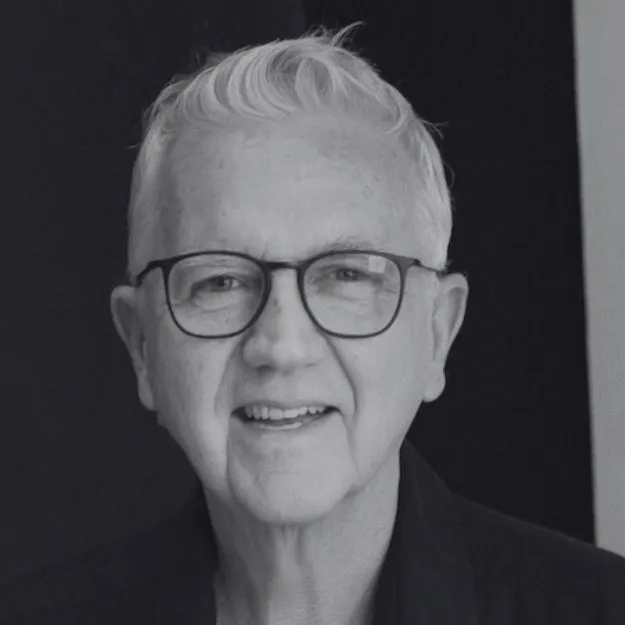
James BurginFounder, PractitionerPro and Thriving Practitioners. Former naturopath, clinic owner and creator of Metaphysical SEO.
About The Author
James Burgin
Founder, PractitionerPro and Thriving Practitioners
James is a naturopath turned digital marketer with 35+ years helping natural health practitioners get found by the people they trained to help. He founded Thriving Practitioners, a community and education platform for practitioners across Australia and New Zealand, and PractitionerPro, the practice growth platform built by practitioners, for practitioners. He lives in Bondi, Sydney.