

Quick Overview
An SEO website for practitioners is built so Google, AI search tools and new clients can quickly understand what you offer, who you help and where you practise. It does not need tricks. It needs a small set of basics done well on every page: one clear search phrase, that phrase in the right places, the answer at the top of the page, short paragraphs, helpful images and a title that earns the click. At PractitionerPro, we build these principles into the structure of every practitioner website, so you start with foundations that help the right people find you.
You finally have a website you feel proud of. The colours are right. The photos feel like you.
Then a few months pass, and enquiries still come from the same places: word of mouth, a friend of a friend, the odd Instagram message.
So you search for your own service in your own suburb. Your website is nowhere to be seen.
If that sounds familiar, you are not alone. And it is rarely your fault.
Why do so many practitioner websites stay hidden on Google?
Most practitioner websites are built to look good first, and the structure Google reads is left as an afterthought. A beautiful page can still be hard for search engines to understand if it never clearly says what you offer and who it is for.
Many practitioners I speak with have been told SEO is complicated, expensive or something to worry about later. So the website goes live with page titles like "Home" and "Services", a heading that says "Welcome", and long paragraphs about philosophy before the reader learns what you actually do.
None of that is wrong. It just is not built to be found.
Here is the good news. You do not need to become an SEO expert. You need a website whose structure does the quiet work for you.
After years as a practitioner and clinic owner, I understand firsthand the frustration of being brilliant at helping patients but struggling to attract them. That's why I've dedicated my career to solving this exact problem for natural health professionals.
What is the 80/20 approach to SEO?
The 80/20 approach means focusing on the small number of SEO basics that create most of the results, rather than chasing everything at once. For a practitioner website, that means getting the structure of each page right before worrying about anything advanced.
This idea comes from the Pareto principle: the observation that a small share of effort often produces most of the outcome. SEO consultant Edward Sturm applies it to search in his Pareto SEO guide, along with a short checklist he runs before publishing any page.
I love it because it matches how I teach practitioners: baby steps over overwhelm. Most practice websites do not need advanced technical work. They need the basics done well, on every page, every time.
Below is our practitioner version of that checklist, in our own words. It is the standard we build into every PractitionerPro website.
What are the 10 SEO principles we build into every practitioner website?
Every page we build has one clear search phrase, places that phrase where Google looks first, answers the visitor's question at the top, and stays easy to skim and read. The ten principles below turn those ideas into a simple checklist.
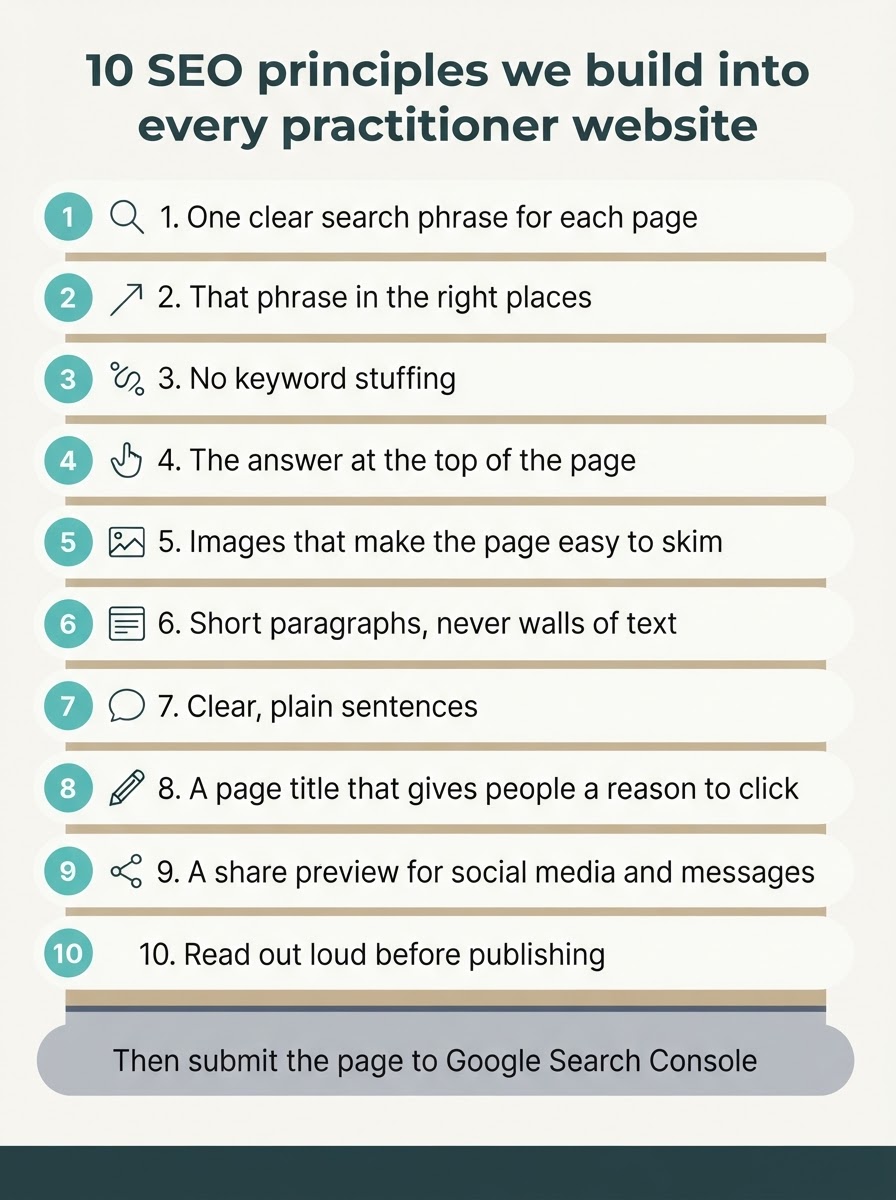
1. One clear search phrase for each page
Every important page should be written around one phrase a new client would actually type, such as "naturopath in Newcastle" or "gut health naturopath online". If a page is not built around a phrase, Google has to guess what it is for.
We choose these phrases with you during your Blueprint session, using the words your clients already use.
2. That phrase in the right places
Where the phrase sits matters more than how often it appears. In order of importance, these are the places we put it:
| Place on the page | What it looks like |
|---|---|
| Page address (URL) | yoursite.com/naturopath-newcastle |
| Page title (the clickable line on Google) | Naturopath in Newcastle: Online and In-Clinic Visits |
| Main heading (H1) | Naturopath in Newcastle |
| Start of the first sentence | "As a naturopath in Newcastle, I support..." |
| A subheading (H2) | What to expect at your first naturopath visit |
| Start of the text under that subheading | "Your first naturopath visit is..." |
3. No keyword stuffing
Repeating the same phrase over and over makes a page awkward to read, and search engines notice. Once the phrase is in its key places, we use natural variations instead, such as "naturopathic support", "gut health" or "your first consultation".
A simple rule: if it would sound strange said out loud to a client, it does not belong on the page.
4. The answer at the top of the page
People decide in seconds whether a page is right for them. Before anyone scrolls, the top of the page should say what you offer, who it is for, where you practise and how to book.
We design every page so the first screen on a phone answers those questions clearly.
5. Images that make the page easy to skim
Someone arriving from Google does not know you yet. Clear images, simple diagrams and photos of your space help them understand the page at a glance.
Each image also gets a short written description, called alt text, so search engines and screen readers understand it too.
6. Short paragraphs, never walls of text
Big blocks of text push readers away, especially on a phone. We keep paragraphs to one to three sentences, with headings that let readers jump to what they need.
7. Clear, plain sentences
Plain words build trust faster than clinical jargon or flowery language. We write in your voice, in sentences a new client can read once and understand.
8. A page title that gives people a reason to click
Your page title is the clickable line people see in Google results. Being relevant is the starting point. A good title also gives a reason to choose you, such as online appointments, a specific focus or your location. We write titles that are specific and honest, never promising results, so they sit comfortably within health advertising rules.
9. A share preview for social media and messages
When someone shares your page in a message or on Facebook, a preview card appears with an image, a title and a short description. We set these for every page, so a shared link looks inviting rather than blank.
10. Read out loud before publishing
Reading a page out loud is one of the simplest quality checks there is. Clunky sentences and repeated words become obvious straight away.
We do this on every page before it goes live, and you approve every page before anything is published.
What happens after a page is published?
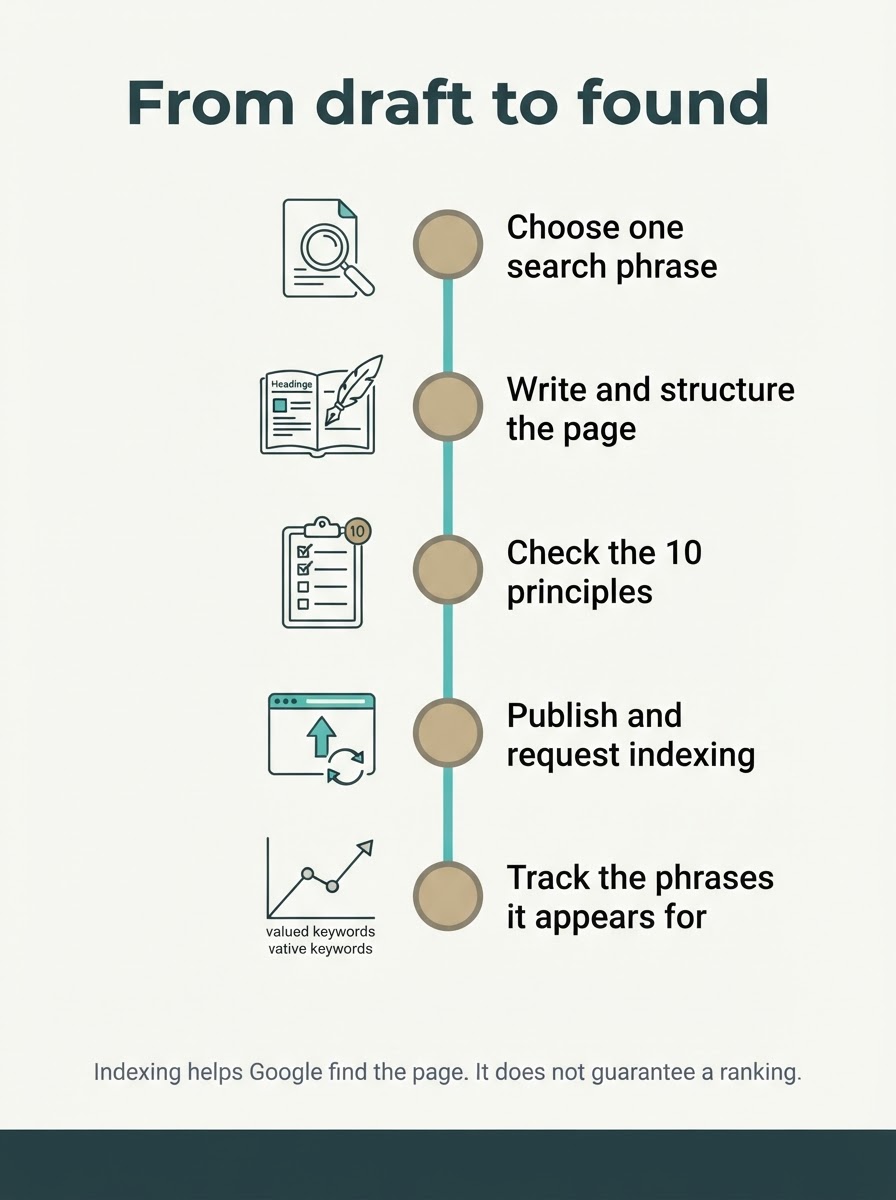
Once a page is live, it is submitted to Google Search Console so Google knows it exists, and the phrases it appears for are tracked over time. This helps Google find the page sooner and shows whether the right people are starting to see it.
Google Search Console is a free tool from Google that shows how your website appears in search. It has a search bar at the top for inspecting any page. You paste in the address of a new or updated page, then choose Request Indexing.
Indexing simply means Google adds the page to its library, so it can show it in search results. Requesting it does not guarantee a ranking, but it means Google is not left to stumble across the page on its own.
From there, we watch which phrases each page starts to appear for. Over time, that shows which pages are close to page one and worth strengthening.
What does this look like in a real practice?
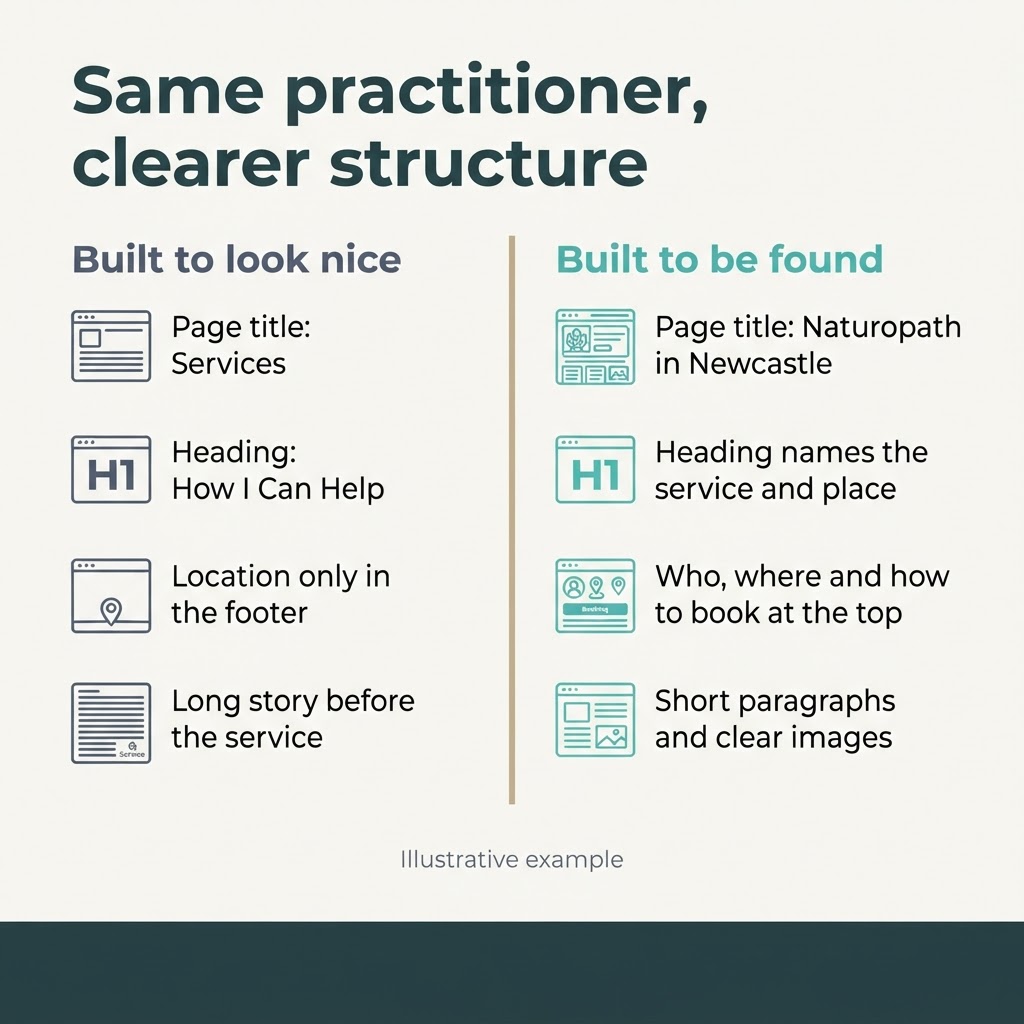
In practice, it usually means small structural changes rather than a whole new message. The same practitioner, the same services and the same voice, organised so Google and new clients can understand them quickly.
Here is an illustrative example. Picture a typical solo practice: a naturopath in Newcastle with a lovely website, but very few enquiries from Google.
Her service page is titled "Services". The main heading says "How I Can Help". The first paragraph is a heartfelt story about why she became a naturopath, and her location appears only in the footer.
Now picture the same page, rebuilt with the ten principles. The address becomes /naturopath-newcastle. The title reads "Naturopath in Newcastle: Online and In-Clinic Visits". The first lines say who she supports, where she practises and how to book.
Her story is still there, a little further down, broken into short paragraphs beside a photo of her consulting room.
Nothing about her care has changed. Her website simply tells Google, clearly, what she does and where.
I've learnt that the most successful practitioners aren't necessarily the most talented clinically. They're the ones who understand that helping people find you is just as important as helping them heal.
Want to see what a visibility review looks like?
Our Sample Visibility Roadmap shows how we read a real practice's Google data, which search phrases are close to page one, and what to fix first. It is anonymised and free to read.
How does PractitionerPro build SEO into your website?
With PractitionerPro, these principles are part of how your website is planned, written and built, not an extra you add later. Your key pages are structured around the phrases your ideal clients search for from day one.
Here is how it works inside The Practice Growth System:
- Blueprint session. One live session to capture your story, your ideal clients, your services and your voice, including the words clients use to describe what they need.
- Written for you. Your website, free guide and welcome newsletters are written in your voice, with a clear search phrase for each key page, and checked against advertising rules before anything goes live.
- Built and connected. Your website, online bookings, free guide, newsletters and program sit together on one platform, with your Google Business Profile aligned to your website.
- Ready for Google. Page titles, descriptions, headings, alt text and share previews are set before launch, new pages are submitted to Google, and your Visibility Roadmap shows where to focus next.
- Ongoing support. Onboarding, email support, live Q&As, a 90-day review with me and Thriving Practitioners membership are all included.
Why not just build it yourself on HighLevel?
PractitionerPro is powered by HighLevel, also known as GoHighLevel (the same platform). HighLevel is strong technology, but it is built for marketing agencies. On its own, it arrives as a powerful, empty workshop.
Its website builder will not choose your search phrases, write your page titles or structure your service pages around how new clients search. Those decisions are where SEO actually lives.
You do not need another piece of software. You need a practice-growth system that has already been designed around how natural health practitioners work.
Your clinical notes and client health records stay in your practice management software. Your website is for being found and being booked, not for storing health information.
How can you check your own website this week?
Choose your most important service page and check it against the basics: one clear phrase, placed where Google looks first, with the answer at the top. It takes about half an hour and needs no technical skills.
- 1
Choose the one service page that matters most to your practice.
- 2
Write down the phrase a new client would type to find that service, including your town, or "online" if you work online.
- 3
Use the checklist below to see where that phrase already appears.
- 4
Open the page on your phone. Without scrolling, can a stranger tell what you offer, who it is for and how to book?
- 5
Read the page out loud. Break any long paragraph into two or three short ones.
- 6
If you made changes and use Google Search Console, paste the page address into the inspection bar at the top and choose Request Indexing.
| Where to check | What to look for | Done? |
|---|---|---|
| Page address (URL) | Your phrase, or a short version of it | [ ] |
| Page title | Your phrase near the start, plus a reason to click | [ ] |
| Main heading | Your phrase, written naturally | [ ] |
| First sentence | Your phrase in the first few words | [ ] |
| A subheading | A natural variation of your phrase | [ ] |
| Top of the page on a phone | What you offer, who it is for, how to book | [ ] |
Not using Search Console yet? That is fine. It is something we can look at together in a Free Practice Review.
Frequently asked questions
Can PractitionerPro build an SEO-friendly website for my practice?
Yes. Every PractitionerPro website is built with these SEO principles in its structure from day one, with a clear search phrase for each key page. The best first step is a Free Practice Review, where I look at your current website and Google Business Profile before we talk.
Do I need to understand SEO to have a website that gets found?
No. You need to understand your clients, and you already do. Our job is to turn the way you describe your work into pages that search engines can read clearly.
How long does SEO take to work for a practitioner website?
SEO builds gradually, and no one can honestly guarantee a timeframe. How quickly pages appear depends on your location, your modality and how established your website already is. Requesting indexing in Google Search Console helps Google find new pages sooner.
Is PractitionerPro just HighLevel with a different name?
No. PractitionerPro is powered by HighLevel, but it comes already shaped around a natural health practice, with the strategy, writing, building and support included. HighLevel on its own is an empty toolkit designed for marketing agencies.
Can I improve the SEO of my current website without changing platforms?
Yes. These principles work on almost any website platform, so you can start with the self-check above. If you are thinking about moving, our Website Switch Guides explain what to consider first.
Do these SEO principles fit within health advertising rules?
Yes. Good SEO is about clarity, not bold claims. We never promise health outcomes in page titles or copy, and every page is checked against advertising rules before you approve it. You can read our approach to compliance.
Ready for a website that is built to be found?
Your website should not need you to become a marketer. It should quietly help the right people find you, understand what you offer and feel confident booking.
That starts with structure. When the basics are built in from the beginning, every new page you add has a better chance of being found.
Book a Free Practice Review
See how PractitionerPro can simplify your practice marketing system. I will look at your website and Google Business Profile before we speak, then we will look at how your pages could be structured so the right people can find you.
It is free, it is friendly, and there is no obligation.
Warmly,
James BurginFounder, PractitionerPro and Thriving Practitioners. Former naturopath, clinic owner and creator of Metaphysical SEO.

About The Author
James Burgin
Founder, PractitionerPro and Thriving Practitioners
James is a naturopath turned digital marketer with 35+ years helping natural health practitioners get found by the people they trained to help. He founded Thriving Practitioners, a community and education platform for practitioners across Australia and New Zealand, and PractitionerPro, the practice growth platform built by practitioners, for practitioners. He lives in Bondi, Sydney.